
Funding: Best practices. FIDE SOC masterclass by Gundula Heinatz
- May 5
- 3 min read
The FIDE Social Commission (SOC) hosted another successful interactive online masterclass on May 4th, cutting through the theoretical noise to deliver a session grounded in hard-won experience. Titled "Funding: Best Practices," the masterclass lived up to its promise, thanks to the candid insights of guest speaker Gundula Heinatz, Board Member of the Swiss Chess Federation.
With the mission to help chess clubs and federations "learn from the best – without repeating the same mistakes," the session provided a clear roadmap for organizations often struggling to secure financial stability. Heinatz, who is responsible for fundraising and elite sports for the Swiss Federation, didn’t offer get-rich-quick schemes. Instead, she presented a mature, digital-first strategy rooted in chess’s unique position as “the most digitized sport in the world.”

A central pillar of the masterclass was the strategic assessment that modern sponsorship is intrinsically linked to digital visibility. Heinatz presented key findings from the Swiss Federation’s recently defined marketing plan, emphasizing that the implementation of such plans "needs to be accelerated." The presentation revealed a fundamental truth for modern chess organizers: sponsors are not just donating; they are investing in visibility through digital platforms, live events, and consistent branding.
Participants were shown that public awareness is a key goal that directly drives sponsorship opportunities. The approach is holistic—it’s not just about asking for money, but about building an entire media ecosystem that provides value.

Heinatz broke down the Swiss Federation’s diverse funding portfolio, moving beyond single-source dependency. The masterclass detailed a practical action plan that starts with the basics: a complete website redesign, creating professional event flyers, and meticulously highlighting sponsor contributions in all digital outputs.
The session showcased real-world examples of this multi-channel approach in action:
Corporate Partnerships: A compelling case study showed a LinkedIn post celebrating the partnership with "Rockstar Recruiting AG" during the Swiss Individual Chess Championships. The post framed the collaboration not as charity, but as a logical union of "Precision. Strategy. Brainpower."
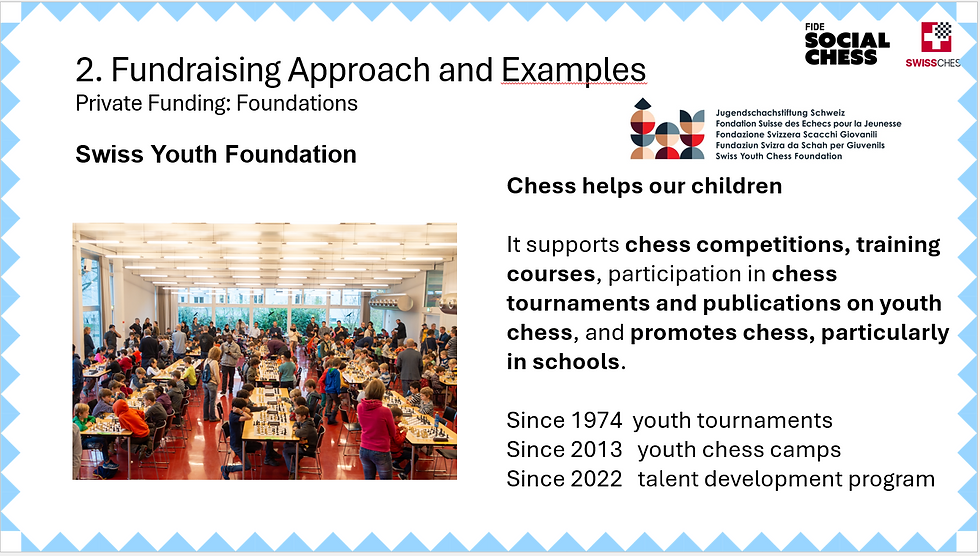
Private Foundations: Heinatz highlighted the long-term support from the Swiss Youth Foundation, which has funded youth chess since 1974, and the Swiss Aid Foundation, the nation's largest sports charity, which is funding five juniors from the SCF squad in 2026.
Community and Public Funding: The concept of making chess accessible to secure regional funds was discussed, alongside an inspiring model of crowdfunding. The "Youth Chess Camp," held during the national championship for over 50 children and supported by a local crowdfunding platform, demonstrated how to turn individual events into community-backed projects.
Perhaps the most valuable segment of the masterclass was Heinatz’s open reflection on her mistakes, fulfilling the SOC’s goal of helping others avoid the same pitfalls. The "Lessons Learned" section was a dose of necessary realism:
"Nobody is waiting for you" – This blunt takeaway underscored the need for proactive outreach.
Readiness is everything – Before knocking on a sponsor’s door, you must have professional marketing materials ready—a flyer, a modern LinkedIn profile, and a functional website are non-negotiable.
Think big, start small – Partners want a “crystal-clear vision,” but initial steps can be modest and focused.

The final lesson reinforced the core message: "Stay digitally present and connected." For a federation or club to attract serious partners, its digital presence must be a living, breathing entity, not a static afterthought.
The "Funding: Best Practices" masterclass provided more than just a strategy document; it delivered a practical philosophy. In a world where financial sustainability is a constant challenge for chess organizers, Gundula Heinatz and the FIDE Social Commission offered a valuable blueprint: build your public awareness through professional digital media, and the sponsorships will follow.


